Hindu Cosmology Explained: Yugas, Kalpas, Manvantaras & The Cyclical Universe
- Shivoham Path

- Aug 23, 2025
- 5 min read

Introduction: A Universe Without Beginning or End
Imagine a universe where time does not move in a straight line but circles endlessly. Where creation, preservation, and dissolution are not singular events but recurring cosmic rhythms, playing out on a scale so vast that human history becomes but a fleeting moment. This is the universe described in Hindu cosmology, a worldview that envisions an infinite cycle of worlds, each emerging, thriving, dissolving, and then emerging again — just as waves rise and fall on the surface of an eternal ocean.
At its core, Hindu cosmology is built on two fundamental ideas:
Time is cyclical — The universe undergoes periodic creations and destructions, measured in vast epochs known as Kalpas, Manvantaras, and Yugas.
The universe is multi-layered — Reality is divided into numerous realms (Lokas), where different beings — gods, sages, humans, demons, and celestial beings — dwell in their own planes of existence.
This intricate and deeply symbolic framework is found across Hindu scriptures, from the Vedas and Upanishads to the Puranas and epics like the Mahabharata and Ramayana.
To truly grasp Hindu cosmology, we must explore its three great cosmic structures:
Kalpas (The grand cycles of creation and dissolution)
Manvantaras (Epochs of cosmic rulers and sages)
Yugas (The four great world ages, marking the moral and spiritual decline of civilization)
And, alongside these time cycles, we must understand the Lokas — the vast and multi-tiered structure of the universe itself.
Kalpas: The Days and Nights of Brahma

At the heart of Hindu timekeeping is Brahma, the creator of the universe. But even Brahma is not eternal. His life is measured in units so vast that they make human history seem insignificant.
One Kalpa is a single day in the life of Brahma. During this time, the universe comes into existence, unfolds its drama of gods and mortals, and then dissolves back into cosmic stillness when the Kalpa ends.
According to the Bhagavad Gita (8.17):
“By human calculation, a thousand Yugas together form one day of Brahma. And such also is the duration of his night.”
The Breakdown of a Kalpa:
One Kalpa = 4.32 billion years
One Kalpa consists of 1,000 cycles of the four Yugas
After a Kalpa ends, an equally long night of Brahma follows, during which the universe rests in dissolution (Pralaya)
A full day and night of Brahma = 8.64 billion years
Brahma’s total lifespan = 100 divine years (311 trillion years!)
Each Kalpa has its own name and is marked by key mythological events. For example:
The previous Kalpa was the Padma Kalpa (“Lotus Kalpa”), at the end of Brahma’s 50th year.
The current Kalpa is the Shveta-Varaha Kalpa (“White Boar Kalpa”), named after Vishnu’s Varaha (boar) incarnation, which lifted the Earth from the cosmic ocean.
At the end of Brahma’s life, the entire universe dissolves into the unmanifest reality, and a new cycle begins with the birth of a new Brahma.
Manvantaras: The Cosmic Administrations
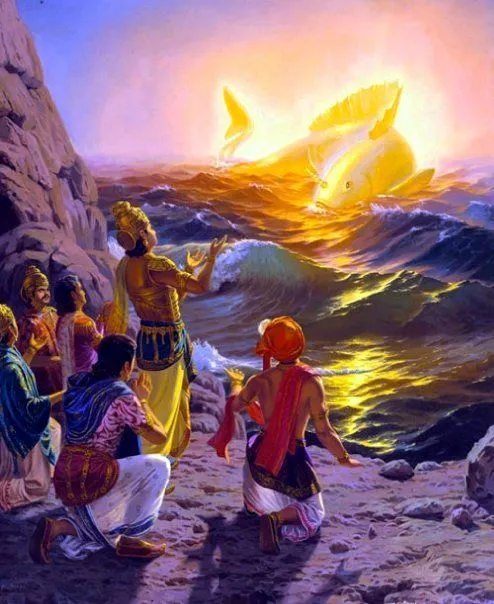
Within each Kalpa, time is further divided into 14 Manvantaras — epochs ruled by a Manu, the progenitor of humanity and the lawgiver of that era. Each Manvantara lasts:
306.72 million years
71 Yuga cycles (Mahayugas)
During each Manvantara:
A new Manu is appointed to govern humanity.
A new Indra (king of the gods) takes the celestial throne.
A new set of deities and rishis (sages) emerges to guide the universe.
We are currently living in the seventh Manvantara, ruled by Vaivasvata Manu. After him, seven more Manus will reign before the current Kalpa ends.
The Vishnu Purana lists the Manus:
“The first Manu was Svayambhuva, then came Svarochisha, Uttama, Tamasa, Raivata, Chakshusha. These six have passed, and the Manu of the seventh Manvantara is Vaivasvata.”
Each Manvantara represents a fresh phase of cosmic governance, with different gods and sages guiding the universe.
Yugas: The Four World Ages
At the most detailed level, time is divided into Yugas, or world ages, each with distinct characteristics and moral conditions. A complete cycle of these four Yugas is called a Mahayuga, lasting 4.32 million years.
Satya Yuga (Golden Age): This is the first and longest Yuga, lasting 1.728 million years. It is an age of truth, wisdom, and spiritual power, where dharma (righteousness) is at its fullest strength, standing on all four legs (4/4). Humans live in perfect harmony with the divine, and there is no corruption, suffering, or ignorance.
Treta Yuga (Silver Age): This Yuga lasts 1.296 million years, and dharma begins to decline (3/4 strength). While spiritual values are still strong, materialism and ego slowly emerge. However, great spiritual beings, such as Lord Rama, still walk the earth, guiding humanity toward righteousness.
Dvapara Yuga (Bronze Age): Spanning 864,000 years, this age sees dharma reduced to half its strength (2/4). Materialism increases, and direct spiritual experience begins to fade. People rely more on rituals and external religious practices rather than inner realization. Knowledge and human lifespan also decline significantly.
Kali Yuga (Iron Age): The current age, lasting 432,000 years, is marked by the lowest level of dharma (1/4 strength). It is a time of moral decay, greed, war, and ignorance. Virtue and righteousness are rare, and society is dominated by material desires, conflicts, and spiritual forgetfulness. According to Hindu tradition, we are currently living in the Kali Yuga, which is said to have begun around 3102 BCE. At the end of Kali Yuga, a divine intervention occurs in the form of Vishnu’s Kalki Avatar, who restores righteousness, after which a new Satya Yuga begins, and the cycle repeats.
The Yuga cycle reflects the rise and fall of civilization, just like the seasons follow a predictable pattern.
Lokas: The Multi-Layered Universe
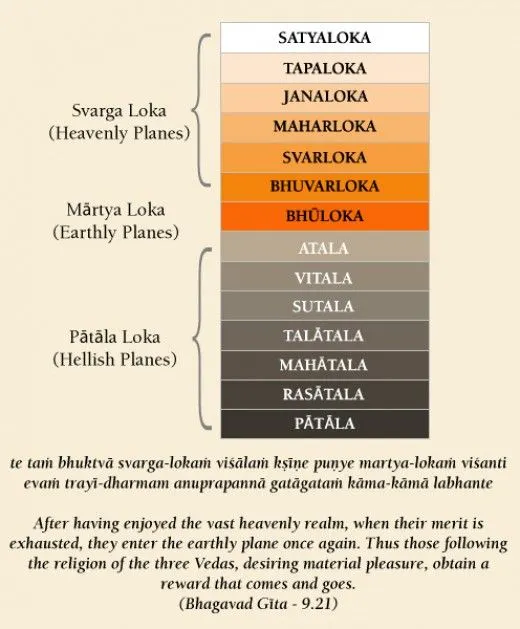
Beyond time, Hindu cosmology also describes the structure of the universe, dividing existence into 14 Lokas (realms).
The Seven Higher Lokas (Heavens)
Satya-loka (Brahma-loka) — Realm of Brahma, highest spiritual plane.
Tapa-loka — Realm of great sages performing austerities.
Jana-loka — Home of divine beings and rishis.
Mahar-loka — Abode of enlightened souls.
Svarga-loka (Indra-loka) — Heaven of Indra, king of the gods.
Bhuvar-loka — Astral plane, home of spirits and ancestors.
Bhu-loka — Earth, the realm of humans.
The Seven Lower Lokas (Underworlds)
Atala — Ruled by Bala, son of Maya.
Vitala — Home of dark spirits and sorcerers.
Sutala — Realm of the demon-king Mahabali.
Talātala — Abode of the Asura Maya.
Mahātala — Home of multi-hooded Nāgas (serpent beings).
Rasātala — Stronghold of demonic forces.
Pātāla (Nāga-loka) — Deepest underworld, home of Vāsuki, the great serpent.
These realms are not eternal heavens or hells, but planes of existence, where souls move according to their karma.
Conclusion: An Ever-Repeating Cosmos
Hindu cosmology is one of the most intricate and vast worldviews ever conceived. It presents a living, breathing universe that undergoes endless cycles of birth and rebirth, mirroring the very nature of existence itself.
While science debates the fate of the universe, Hindu thought has long proposed a vision of eternally recurring creation, bound by cosmic law (ṛta) and divine will. The question is not whether time will end — but when the next cycle will begin.


Comments