D60 Shashtiamsha: Past-Life Karma at Full Resolution
- Shivoham Path

- May 1
- 13 min read

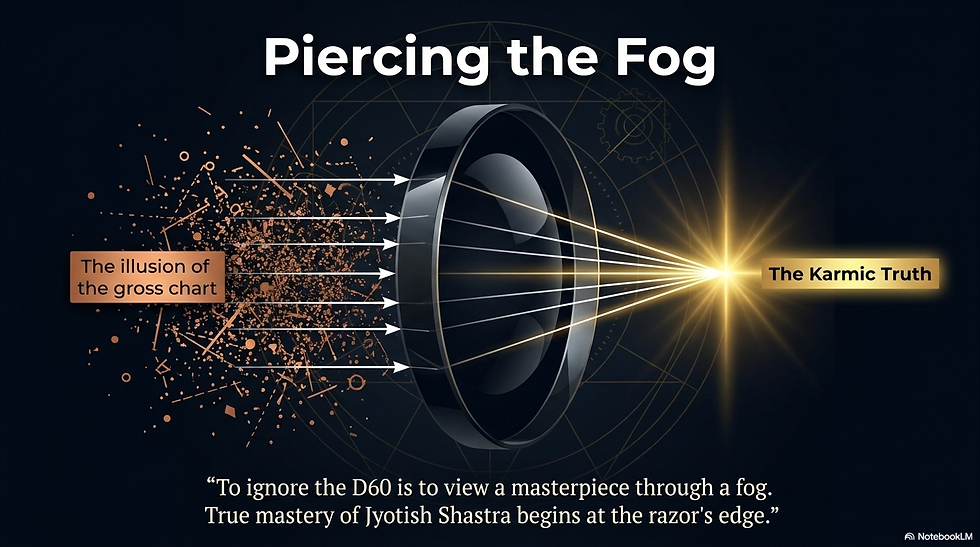
The Shashtiamsha, or D-60 chart, is the absolute pinnacle of Vedic astrology's divisional architecture. It is the microscopic X-ray, or the cosmic CT scan, of the soul's accumulated karma. While the Rasi (D-1) chart outlines the physical body and the broader strokes of destiny in this incarnation, the D-60 chart dives into the supra-conscious plane, revealing the exact heritage of karma carried over from countless past births

The Primacy of D60: Parashara’s Mandate
In the supreme esoteric text, Brihat Parashara Hora Shastra, Sage Parashara explicitly gives the highest weightage to the D-60 chart, elevating it above even the Rasi (D-1) and Navamsa (D-9) charts in his Vimsopaka Bala (20-point strength) scheme. In the Dasavarga (10-division) scheme, the Rasi chart is allotted 3 points, the Navamsa 1.5, but the Shashtiamsha is given a staggering 5 points. Parashara clearly instructs that no chart should be judged without it, as it holds the definitive blueprint of our Prarabdha Karma (destiny ripe for experience).

What D60 Answers: The Ultimate Karmic Blueprint
The D-60 chart does not merely describe what will happen; it explains why it is happening. It determines the karma inherited by one's own past actions and deep-seated desires. When you encounter inexplicable events in a person's life: sudden wealth, unprovoked enmity, or tragic losses that defy the logic of the D-1 chart, the answers lie hidden in the D-60. It maps the accumulated karmic debts and merits that silently condition everything in the present incarnation.
The Architecture of D60 (Calculation Mechanics)
To cast this highly sensitive chart, each 30-degree zodiac sign is divided into 60 equal parts. Therefore, each Shashtiamsha measures exactly 30 minutes of arc, or just half a degree. The counting is sequential: for planets posited in odd signs, the counting begins from the sign itself and moves in direct order; for even signs, the counting also starts from the sign itself but moves in reverse order.

The 60 Shashtiamsha Deities: The Vibrations of Karma
Every 1/2 degree of the zodiac is guarded by a specific presiding deity or cosmic vibration. Parashara assigned names to all 60 divisions, classifying each as either inherently benefic (auspicious) or malefic (terrible).
Malefic Shashtiamshas: Names like Ghora (terrible/violent), Rakshasa (demonic), Kulaghna (destroyer of lineage), Garala (venom), Yama (death personified), and Kaala (time/destruction) represent areas where the soul committed severe transgressions in past lives. A planet falling here carries a dark karmic mandate and will exact painful debts during its planetary period.
Benefic Shashtiamshas: Names like Deva (divine), Kubera (celestial treasurer), Amrita (immortal nectar), Sudha (ambrosia), and Brahma (creator) represent the Purva Punya (past-life merit) of the soul. Planets residing in these degrees bestow profound grace, protection, and unearned blessings in this lifetime.

Reading the D60: Strong vs. Weak Placements
The interpretation of the D-60 relies heavily on these deity placements and the house dignity of the planets. If a planet is strong in D-60 (placed in an exaltation, own, or friendly sign, and in a benefic Shashtiamsha), the karma being carried is predominantly positive; the native's past-life spiritual bank account is full regarding that planet's significations. Conversely, if a planet occupies a malefic Shashtiamsha or is relegated to the 6th, 8th, or 12th houses in the D-60, the native's struggle has deep, painful roots, often manifesting as chronic diseases, inescapable debts, or powerful hidden enemies.
The D60 Lagna: The Foundational Inheritance
The Ascendant of the D-60 chart reveals the inner, foundational strength of the soul and its power to manage crises. It shows the core karmic vibration the soul chose for this incarnation. For example, if the D-60 Lagna falls in a Deva (Divine) amsha, the native possesses the inherent purity of a Yogi; if it falls in Davagni (forest conflagration) or Ghora, the soul's baseline experience will be filled with intense, burning struggles.

The Moon in D60: The Repository of Emotional Karma
The Moon represents the Chitta (unconscious mind), which acts as the cosmic hard drive holding the emotional memories, traumas, and subliminal impressions of countless past births. If the Moon falls in a terrifying Shashtiamsha like Rakshasa (demonic) or Garala (poison) in the D-60, the native will experience inexplicable emotional suffering, phobias, or mental agonies. This explains why some individuals suffer from profound depression or paranoia despite having a seemingly flawless D-1 chart; their soul is processing the bitter karmic memories of the past.

Cross-Referencing D60 with D1: The Grand Synthesis
The ultimate secret of advanced esoteric astrology is the synthesis between the Sthoola (gross/D-1) and the Sookshma (subtle/D-60).
If a planet is weak, debilitated, or afflicted in the D-1 chart, but attains a powerful, benefic position in the D-60, the evil effects of the natal chart are eventually cancelled out. The soul's past-life merit will unexpectedly rescue the native.
Conversely, if a planet is exalted and beautiful in the D-1 chart, but falls in a malefic Shashtiamsha (like Bhrashta or Kalinasa) in the D-60, the promised worldly success will violently collapse, or the planet will fail to deliver during its Dasha, bringing sudden karmic shocks.


The Practical Limitation: The Razor's Edge of Time
Because each Shashtiamsha division is only 1/2 of a degree, the D-60 Ascendant changes every 2 minutes. Therefore, reading the D-60 Lagna requires birth time accuracy down to the exact second. If the birth time is uncertain by even a few minutes, the entire chart shifts, leading to erroneous karmic judgments. In cases of uncertain birth times, advanced astrologers treat the D-60 directionally—they ignore the D-60 Lagna and instead focus solely on the specific Shashtiamsha deities the planets occupy (since the slower-moving planets will remain in their respective Shashtiamshas for much longer), or they recast the chart (D60R) using the D-1 Lagna as the anchor.
60 Shashtiamsha deities: In detail
The 60 Shashtiamsha (D-60) deities represent the ultimate, microscopic resolution of a soul's karmic ledger. Because each Shashtiamsha measures a mere half-degree (30 minutes of arc) of the zodiac, the specific deity ruling that tiny sliver of space acts as the supreme cosmic judge over the planet placed within it. These deities are not abstract symbols; they are exact energetic vibrations of Purva Punya (past-life merits) or Sanchita Karma (accumulated past-life sins) that actively condition the events of the present incarnation.
The Architecture of the 60 Deities
In the calculation of this profound chart, the sequence of the 60 deities unfolds in direct order (from 1 to 60) for planets posited in odd signs (Aries, Gemini, Leo, Libra, Sagittarius, Aquarius). However, for planets placed in even signs (Taurus, Cancer, Virgo, Scorpio, Capricorn, Pisces), this exact order is reversed, meaning the 60th deity becomes the 1st, and the 1st becomes the 60th.
Every deity is strictly classified as either Benefic (B) or Malefic (M). If a planet occupies a Benefic Shashtiamsha, it guarantees that the karma carried over regarding that planet's significations is pure, and it will produce highly auspicious results, whereas a Malefic Shashtiamsha brings inescapable karmic debts, suffering, and destruction.
Here is how the 60 deities are categorized by their esoteric vibrations:
1. The Terrifying and Destructive Forces (The Agents of Retribution)
These deities govern the segments where the soul committed grave transgressions in previous lifetimes, bringing violence, sudden endings, and divine punishment to the present life:
Ghora (M): The 1st and 34th deity, meaning awful, violent, and full of horror. It indicates severe, burning struggles and violent karmic reactions.
Rakshasa (M): The 2nd deity, representing demonic or evil spirits. It signifies dark, untamed desires from past lives that haunt the native's subconscious mind.
Kaala (M): The 15th, 32nd, and 44th deity, representing Time personified, the dark destructive principle, and the ultimate destroyer of the universe.
Yama (M) and Mrithyu (M): Yama, the 35th deity, is death personified, acting as the cosmic enforcer of moral duties. Mrithyu, the 31st deity (the son of Mars), brings literal or metaphorical death and inescapable endings.
Karaladamshtra (M): The 48th deity, depicted as frightful-teethed. This vibration actively awards severe karmic punishments, often manifesting through dacoits or terrifying events.
Kala Pavaka (M): The 51st deity, representing the destructive fire at the end of the world.
2. The Forces of Illusion, Poison, and Lineage Destruction
These are insidious karmic blockages, often representing curses, deceit, or the decay of a family line:
Garala (M) and Vishadagdha (M): Garala (the 9th deity) is literal poison or venom. Vishadagdha (the 40th deity) means "destroyed by venom" or "consumed by grief". Planets here indicate deep, toxic traumas or literal poisoning in past incarnations.
Maya (M): The 11th deity, representing deceit, jugglery, and the heavy illusion (Maya) that blinds the soul to ultimate truth.
Bhrashta (M): The 7th deity, representing the fallen and vicious. It indicates a soul who fell from moral standards in a past life.
Kulaghna, Kulanasa, and Vamsakshaya (M): The 8th, 41st, and 42nd deities respectively. They mean the ruining of a family, the descent not growing further, or the complete destruction of the race/lineage. When key planets fall here, the native may be the last of their bloodline or suffer intense family tragedies.
3. The Divine and Liberating Forces (The Agents of Grace)
These are the most highly evolved degrees of the zodiac. Planets falling here bring profound spiritual merit, pure intellect, and divine protection:
Deva (B): The 3rd and 25th deities. This represents the purely divine, spiritual side of the native, often granting the wisdom of a true priest or Yogi.
Brahma, Vishnu, and Maheswara (B): The 22nd, 23rd, and 24th deities represent the Supreme Triad. Brahma is the Universal Father and creator; Vishnu is the pious lawgiver and sustainer; Maheswara (Shiva) is the great lord of cosmic destruction. Planets here are protected by the highest echelons of divine consciousness.
Amrita (B) and Sudha (B): The 17th, 37th, 38th, and 57th deities represent the immortal nectar or ambrosia of the Gods. They bring supreme healing, immortality of reputation, and spiritual rejuvenation.
Nirmala (B): The 53rd deity, meaning resplendent, pure, stainless, and virtuous. It reflects a soul deeply cleansed of earthly attachments.
4. The Elemental and Nature Spirits
These deities govern specific material talents, environmental affinities, and the wealth of the earth:
Kubera (B) and Yaksha (B): The 4th and 5th deities. Kubera is the celestial treasurer, and Yaksha is the celestial singer and protector of wealth.
Kinnara (B): The 6th deity, representing mythical beings and celestial musicians.
Apampathi (B) and Payodhi (B): The 13th and 58th deities. Apampathi is Varuna, the god of rain and oceans, while Payodhi literally translates to the unfathomable ocean.
Marut (B): The 14th deity, the wind god, representing supreme swiftness and elemental power.
How the Deities Decode Destiny
The ancient sages, including Parashara and Garga, explicitly stated that the specific Bhava (house) whose lord falls into a malefic Shashtiamsha will be destroyed or severely diminished. Conversely, houses governed by planets in benefic Shashtiamshas will powerfully flourish.
For example, if the 10th lord (representing profession and Karma) falls into the Bhrashta (fallen) Shashtiamsha, the native will be wretched and miserable in their profession, no matter how strong the D-1 chart appears. If a benefic planet occupies the 3rd house and is simultaneously placed in the Yaksha (celestial singer) Shashtiamsha, the native will effortlessly achieve high musical fame. If the 2nd lord (wealth) is placed in the Kubera Shashtiamsha, the individual will be extremely affluent, possessing the treasury of the Gods. If a planet situated in the 8th house falls into the Payodhi (ocean) Shashtiamsha, it points to a distinct, past-life fear of water or danger from drowning in this life.
Therefore, understanding the 60 deities provides the ultimate key to deciphering why inexplicable events happen in a native's life revealing the exact, hidden karmic vibrations that either bind the soul to earthly suffering or elevate it toward Moksha.
What happens when a planet is weak in D60?
In the highly advanced esoteric architecture of Vedic astrology, the Shashtiamsha (D-60) chart acts as the ultimate cosmic ledger of the soul, revealing the absolute truth of our Sanchita Karma (accumulated past-life deeds) and the exact spiritual vibration we carry across incarnations. When a planet is weak in the D-60 chart, it indicates a profound spiritual deficiency or a heavy karmic debt that the soul failed to resolve in its previous births.
A planet is considered weak and afflicted in the D-60 if it is debilitated, combust, defeated in planetary war, placed in an enemy's sign, associated with natural malefics, or relegated to the Dusthana (evil) houses specifically the 6th, 8th, or 12th. Additionally, its weakness is cemented if it falls into a malefic Shashtiamsha division (such as Ghora, Rakshasa, or Garala), meaning the planet's energy is vibrating at a frequency of past-life transgressions and sins.
Because the D-60 chart dictates the true, underlying strength of a planet's destiny, a weak planet here will inevitably exact its karmic toll during its Dasha (main period) or Antardasha (sub-period) by bringing forth severe obstructions and problems. Wise scholars specifically study the 6th, 8th, and 12th houses of the D-60 chart to decode these deeply rooted miseries. Because the D-60 mathematically amplifies these energies (as 10 x 6 = 60), a weak planet connected to these houses will trigger inescapable struggles, manifesting as chronic and inexplicable diseases, deep financial debts, and painful litigation. The soul may also be forced to confront powerful hidden enemies, intense business rivalries, and a sudden, humiliating loss of social and professional status.
From an esoteric and reincarnational perspective, this weakness shows that the individual misused the divine energies of that specific planet in a past life. Therefore, the current incarnation demands purification through restriction and struggle. Even if a planet appears exceptionally strong, exalted, or seemingly flawless in the gross physical chart (D-1 Rasi), its hidden weakness in the D-60 reveals that the promised worldly success is merely a temporary illusion (Maya). When that planet's period arrives, the material foundation will inevitably crumble, forcing the soul to pay its cosmic debts and realign with the Divine.
What are the names of the 60 Shashtiamsha deities?
In the microscopic and highly esoteric architecture of the Shashtiamsha (D-60) chart, the zodiac is divided into 60 segments of exactly half a degree (30 minutes of arc) each. Every single segment is presided over by a specific deity representing the exact cosmic vibration of a soul's Purva Punya (past-life merit) or Sanchita Karma (accumulated past-life sins).
For planets placed in odd signs, the sequence of these deities is counted in direct order from 1 to 60. For planets posited in even signs, the counting is strictly reversed, meaning the 60th deity becomes the 1st, and the 1st becomes the 60th.
The 60 Shashtiamsha deities, their inherent benefic (B) or malefic (M) nature, and their karmic significations are as follows:
Ghora (M): Awful, violent, and full of horror; indicates severe struggles, violent karmic reactions, and fearful past-life actions.
Rakshasa (M): Demoniacal and representing evil spirits; signifies dark, untamed desires and demonic forces haunting the subconscious.
Deva (B): Divine and spiritual; grants the wisdom, purity, and noble nature of a true priest or Yogi.
Kubera (B): The celestial treasurer; grants the supreme wealth and treasures of the Gods.
Yaksha (B): The celestial singer and protector of wealth; creates strategic manipulators and those who guard riches.
Kinnara (B): A mythical celestial musician with a human head and the form of a horse; relates to musicians, dancers, and writers.
Bhrashta (M): Fallen and vicious; indicates a soul who fell from moral standards or became adulterous in a past life.
Kulaghna (M): The destroyer of the family; brings a bad name to the lineage or acts as the ruin of a family line.
Garala (M): Poison or venom; points to deep, toxic traumas or literal poisoning in past incarnations.
Vahni / Agni (M): Fire, gastric fluid, and appetite; relates to performing fiery ceremonies and intense, burning karma.
Maya (M): Deceit, jugglery, and heavy illusion; binds the soul in fraud and blinds it to the ultimate truth.
Purishaka / Pretpurish (M): Dirt, excrement, and the kingdom of the dead; an impure karmic state.
Apampathi (B): The ocean and Varuna (the rain god); a deeply watery, emotional, and unfathomable vibration.
Marut / Devganesh (B): The wind god and destroyer of evils; represents swiftness, elemental power, and protection.
Kaala (M): Time personified and dark blue in color; the destructive principle of the universe and an indicator of death.
Sarpa / Ahibhag (M): The snake; a winding, deceptive motion often belonging to a cheat, rogue, or hidden karmic venom.
Amrita (B): Immortal nectar; brings supreme healing, rejuvenation, and spiritual immortality.
Indu (B): The Moon and the number one; a nourishing, delicate, and deeply comforting cosmic vibration.
Mridu (B): Moderate, soft, and tender; grants gentle protection and a peaceful aura.
Komala (B): Tender, agreeable, and beautiful; bestows a delicate and pleasing physical or energetic expression.
Heramba (B): Lord Ganesha as the boastful hero or elephant-faced god; removes obstacles and grants profound wisdom.
Brahma (B): The Universal Father and creator; initiates sacred knowledge and pure, new spiritual beginnings.
Vishnu (B): The second deity of the sacred Triad; the pious lawgiver, preserver, and sustainer of the soul.
Maheswara (B): Lord Shiva, the third deity of the Triad; entrusted with the great destruction of obsolete forms to liberate the soul.
Deva (B): The divine and the noble; identical in nature to the 3rd deity, carrying pure, hospitable, and godly light.
Ardra (B): Moist and watery; functions as a life-giver and relates to saints or spiritual heads.
Kalinasa (B): The destruction of strife; a vibration that actively destroys evil, war, and past-life sins.
Kshiteesa (B): The ruler of the earth; bestows the karma of kings, landlords, and powerful worldly authority.
Kamalakara (B): A lake full of lotuses; signifies extreme prosperity, glory, and an assemblage of virtuous qualities.
Gulika / Mandi (M): Saturn's son; a sluggish, dirty, incompetent, and highly restrictive karmic blockade.
Mrithyu (M): The son of Mars; represents inescapable death, destruction, and violent endings.
Kaala (M): Same as the 15th deity; the dark force of time and ultimate destruction.
Davagni (M): A forest conflagration or jungle fire; the soul's baseline experience here is filled with intense, burning struggles.
Ghora (M): Same as the 1st deity; dreadful, terrible, and violent,,.
Yama (M): Death personified; acts as the cosmic enforcer of moral duties and punisher of sins.
Kantaka (M): A thorn; represents a troublesome fellow, severe impediments, or an enemy of peace and order.
Sudha (B): Nectar and ambrosia; the pure waters of the Ganges that grant divine nourishment and learned wisdom.
Amrita (B): Same as the 17th deity; immortal nectar bringing spiritual rejuvenation.
Poornachandra (B): The Full Moon; spreads complete, radiant light and grants a flawless reputation.
Vishadagdha (M): Destroyed by venom or consumed by grief; points to toxic traumas or a deeply poisoned past-life experience.
Kulanasa (M): Same as the 8th deity; the total destruction of the lineage and family line.
Vamsakshaya (M): Descent not growing further; indicates the decay of a bloodline and the cessation of worldly family growth.
Utpata (M): A portentous phenomenon boding calamity; represents public disasters, turmoil, and severe karmic shocks like earthquakes.
Kaala (M): Same as the 15th and 32nd deities; the destructive force of time.
Saumya (B): Relating to the Moon; extremely handsome, auspicious, gentle, and sober.
Komala (B): Same as the 20th deity; delicate, soft, and agreeable.
Seetala (B): Cold; carries the soothing vibration of the Moon, camphor, and sandalwood.
Karaladamshtra / Drastakaral (M): Frightful-teethed; an aggressive, terrifying force that actively awards severe punishments or encounters with dacoits.
Chandramukhi / Indu Mukh (B): Having the beauty of the Moon; an intensely charming, beautiful, and alluring face.
Praveena (B): Clever, skilled, and versed in high knowledge; grants supreme efficiency and expertise.
Kalapavaka (M): The destructive fire at the end of the world; the ultimate, unadjustable cosmic burning.
Dandayudha (M): The staff held by an ascetic or a Brahmin; represents the authority to punish the guilty and exact cosmic justice.
Nirmala (B): Resplendent, sinless, stainless, and virtuous; a soul deeply cleansed of earthly attachments.
Saumya (B): Same as the 45th deity; favorable, clean, and gently adjustable.
Kroora (M): Pitiless, mischievous, bloody, and terrible; a cruel vibration demanding harsh karmic repayment.
Atiseetala (B): Very cold or freezed; an unresponsive but deeply pure state.
Amrita (B): Same as the 17th and 38th deities; the indestructible nectar of immortality.
Payodhi (B): The unfathomable ocean or milk tank; a vast repository of deep, watery karmic consciousness.
Bhramana (M): Wandering and travelling; the curse of an unsettled, roaming soul unable to find peace.
Chandra Rekha / Indurekha (B): The digit or streak of the Moon; a highly progressive, beautifully subtle, and auspicious divine mark.
New course is about to begin that becomes the foundation of everything that is needed for spiritual jyotish, join this revolution by building that strong foundation first, click here to enroll.


Your comparison of the D-1 as the broad outline and the D-60 as the fine karmic resolution made this difficult subject much easier to follow. The most important section for me was the birth-time warning: when the Lagna can shift in roughly two minutes, apparent precision can become misleading very quickly. I also appreciated the reminder to cross-reference planetary dignity rather than treating a benefic or malefic Shashtiamsha name as the whole verdict. For anyone who wants to establish the sidereal Rashi, Nakshatra and planetary positions before exploring the divisional charts, a helpful starting point is Deckaura