D20 — Vimshamsha: Mapping the Soul’s Spiritual Blueprint


The study of Vedic astrology is a Vedanga, a limb of the Vedas intended to reveal the hidden mysteries of human existence. In the Bhrigu Samhita, Maharishi Bhrigu and Dr. T.M. Rao emphasize that while the primary natal chart explores Samsara (the material illusion of physique, family, and fortune), the Vimshamsha (D-20) chart is a specialized divisional map designed to identify the soul’s "spiritual DNA."
Where the standard birth chart describes the "Physique, mind, and soul" (1st House) in a mundane context, the D-20 focuses on the native’s capacity for Upasana (dedicated spiritual practice). This practice is synthesized through five divine methods of worship:

Abhigamana: The initial approach or mental orientation toward the divine.
Upadana: The meticulous preparation of materials and the internal self for worship.
Ijya: The act of oblation, sacrifice, or ritual performance.
Svadhyaya: The recitation and study of sacred texts, transforming Mercury’s intellectual "Banker" energy into spiritual inquiry.
Yoga: The ultimate union with the divine consciousness.
By analyzing the D-20, a scholar identifies the soul’s "cosmic frequency." This frequency is governed by the Sun and Moon, which the source defines as the primary significators of the Soul and Mind, respectively. Together, they reveal the native’s specific deity alignment and the precise vibration of their spiritual path.
The Sacred Architecture: Calculating the D-20
The Vimshamsha is constructed by dividing each 30-degree zodiac sign into 20 equal parts, with each division spanning exactly 1 degree and 30 minutes. This creates a highly specific map that distinguishes the native’s moral inclination from their outward social standing. The starting sign for counting these divisions is determined by the modality of the sign where the planet or Ascendant resides:

Initiation of D-20 Counting
Sign Modality | Signs Included | Starting Sign for Counting |
Movable | Aries, Cancer, Libra, Capricorn | Aries |
Fixed | Taurus, Leo, Scorpio, Aquarius | Sagittarius |
Dual | Gemini, Virgo, Sagittarius, Pisces | Leo |
The Four Pillars of Spiritual Practice
In the D-20, the twelve houses of the Bhrigu Samhita transform from material indicators into spiritual pillars.
The Lagna (Ascendant): The Inner Yogi
The 1st house, which signifies "Physique, will-power, and soul," represents the "Inner Yogi" in the D-20. It maps the native’s spiritual discipline and the strength of their will to renounce material attachments. A strong Lagna here suggests a soul with a clear "physical complex" geared toward spiritual endurance.
The 5th House: Mantra Shakti
The source defines the 5th house through "Education, speech, and knowledge." In the D-20 blueprint, this manifests as Mantra Shakti—the perfection of sacred sounds and devotion. Benefic influences here indicate that the native’s speech is infused with spiritual power, leading to Mantra Siddhi (spiritual perfection).
The 9th House: Lineage and Divine Power
Signifying "Destiny, Dharma, and Divine power," the 9th house in the D-20 reveals the role of the Guru and the Dharma Devata. It represents the spiritual traditions carried from past lives and the "fame" one acquires through religious devotion rather than worldly recognition.
The 12th House: Cosmic Dissolution
While the material 12th house signifies "Expenditure and loss," in the D-20 it represents the dissolution of the ego. The source mentions the "contact of foreign places"; esoterically, this indicates the soul's journey into transcendental realms beyond the physical body, mapping the path to Samadhi and final emancipation.
Planetary Vehicles and Divine Vibrations
The Bhrigu Samhita identifies the mundane "business" of each planet for instance, Mars representing doctors or scientists, and Mercury representing bankers or comedians. In the D-20, these roles elevate into divine archetypes, acting as vehicles for specific spiritual vibrations:
The Sun: The "Saint and Devotee" becomes the vibration of Lord Shiva or Lord Rama, representing the ultimate authority of the soul.
The Moon: The "Actor, Dancer, or Poet" transforms into Bhakti, Shakti, Gauri, Parvati, or Lord Krishna, representing the mind’s emotional devotion.
Mars: The "Engineer or Commander" elevates to the protective valor of Hanuman, Narasimha, or Subramanya.
Mercury: The "Banker and Economist" becomes the capacity for sacred study and the intellect of Lord Vishnu.
Jupiter: The "Teacher and Professor" represents the Supreme Teacher, Lord Brahma, Shiva, or Dakshinamurthy (especially when Sun-influenced).
Venus: The "Artist and Musician" expresses the grace of Lakshmi, Gauri, or Vaishno Devi.
Saturn: The dealer of "hardware and huge works" becomes the lord of austerity, aligned with Bhairava, Narayana, or Yama.
Rahu: The force of "unauthorised efforts" is harnessed for fierce transformation through Durga, Kali, or Shiva with serpents.
Ketu: The Moksha Karaka (significator of liberation) is aligned with Ganesha or Chandi, clearing the path of spiritual obstacles.
Advanced Synthesis: D-20 and the Navamsa Karakamsha
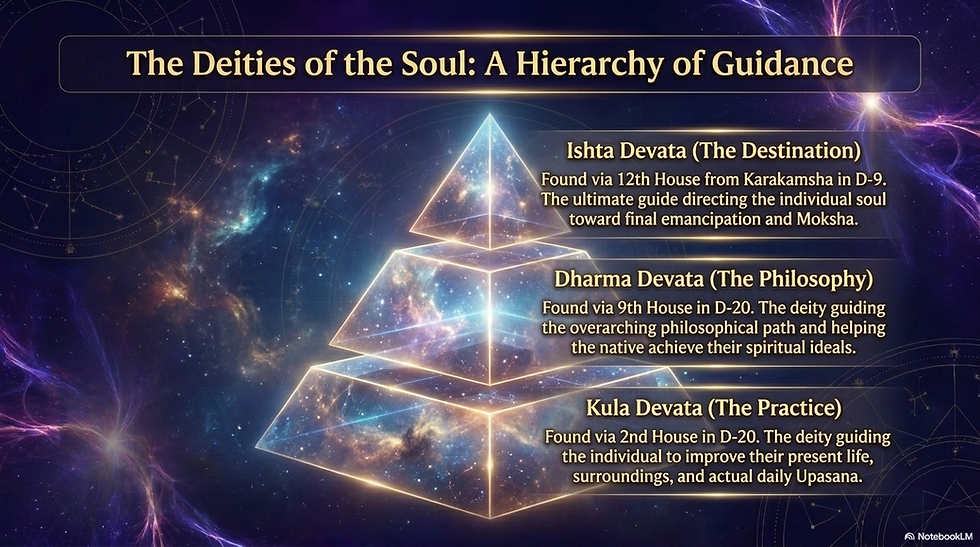
To synthesize a complete blueprint, the scholar must look at the "Degrees of the Planets." As noted on page 11 of the source, the planet with the highest degree in the natal chart is the key to this calculation, the Atmakaraka. The sign occupied by this planet in the Navamsa (D-9) is known as the Karakamsha.
The Karakamsha reveals the deepest desires of the soul. By identifying the 12th house from the Karakamsha, the practitioner finds the Ishta Devata—the specific guiding deity that leads the soul toward liberation. This synthesis bridges the "Degrees of the Planets" with the D-20’s spiritual framework, providing a clear map for achieving Moksha.
How do planet degrees affect D20 and Navamsa results?
In the esoteric architecture of Vedic astrology, the precise degrees and minutes a planet occupies in the natal chart (Rasi) are not mere mathematical coordinates; they are the exact karmic timestamps that map the soul's evolutionary journey across countless incarnations. These degrees act as the master keys that unlock the higher-dimensional, spiritual charts specifically the Navamsa (D-9) and the Vimshamsha (D-20 by dictating exactly where the cosmic energies will manifest.
Here is the profound mechanics of how planetary degrees govern the inner, spiritual realities of the D-9 and D-20 charts:
1. The Microscopic Division of Karma (Calculation Mechanics)
Every zodiac sign spans exactly 30 degrees. The Navamsa chart divides this 30-degree span into 9 equal segments of 3 degrees and 20 minutes each. The Vimshamsha (D-20) chart dives even deeper into the spiritual ether, dividing the 30-degree sign into 20 highly sensitive segments of 1 degree and 30 minutes each. The precise degree a planet holds in the birth chart dictates which specific fractional segment it falls into, completely shifting its placement, dignity, and spiritual mandate in the D-9 and D-20 charts. Through this magnification, the unwanted "gross" material load of the zodiac is discarded, revealing the concentrated power centers of the soul.
2. The Atmakaraka and the Soul's Descent
To understand the ultimate reason for birth, we must evaluate the degrees of all planets (excluding Ketu) to determine the Chara Karakas (temporary spiritual significators for this lifetime). The planet that has advanced to the absolute highest degree of longitude in any sign becomes the Atmakaraka, the king of the chart and the exact representative of the individual soul (Jiva) and its supreme desires.
The exact Navamsa sign that this highest-degree planet occupies becomes the Karakamsa. The Karakamsa reveals the deepest, hidden desires of the soul that forced it to reincarnate, while the trines from it indicate the Atma-shakti (soul power) available to achieve those desires. Conversely, the planet with the lowest degree of longitude becomes the Darakaraka, representing the spouse and the earthly partnerships that bind the soul to the material plane.
3. Vargottama and Pushkara Degrees: The Nectar of the Gods
Certain exact degrees act as cosmic portals of supreme blessing. If a planet's natal degree places it in the exact same sign in both the D-1 and the Navamsa (D-9), it achieves Vargottama status. This alignment grants the planet extraordinary strength to manifest its karmic mandate, elevating the native both materially and spiritually.
Furthermore, ancient seers identified specific degrees within each sign known as Pushkaramsha, which automatically place the planet into a Pushkara Navamsa—a highly auspicious, life-giving zone ruled by benefic energies. Even if a planet rules a difficult house or is a natural malefic, occupying these exact nectar-like degrees heals the soul's afflictions and brings extraordinary grace and spiritual elevation.
4. The 64th Navamsa and Mrityu Bhaga: The Fatal Degrees
Just as degrees grant blessings, they also hold the codes for crisis, transformation, and physical death. The 64th Navamsa is a highly sensitive karmic point found exactly 8 signs, or exactly 210 degrees, away from the natal degree of the Moon or the Ascendant. When malefic planets transit the exact degree of this Navamsa, or when its ruling planet runs its planetary period, it acts as a trigger for severe health challenges, tragedies, or the end of an incarnation.
Additionally, there are Mrityu Bhaga (fatal degrees) specified for every planet. If a planet sits exactly on its designated death-inflicting degree, its capacity to cause suffering is profoundly magnified. If the Dasha (planetary period) of a planet in Mrityu Bhaga operates and is simultaneously activated by a malefic transit to its 64th Navamsa, it can shatter the physical vessel and force the soul to transition.
5. Vimshamsha (D-20) and the Architecture of Upasana While the Navamsa reveals the Prarabdha Karma (the destiny that must be experienced), the Vimshamsha (D-20) reveals the soul's Upasana, its dedication to worship, esoteric studies, and ultimate liberation (Moksha). Because the D-20 chart changes every 1 degree and 30 minutes of natal planetary movement, it requires an incredibly precise birth time. The exact degree of a planet places it into one of these 20 segments, revealing the specific deities the native is karmically bound to worship, their inherent capacity for deep meditation, and the philosophical path that will awaken their higher consciousness.
In summary, the degree of a planet is the thread of destiny. It weaves the physical reality of the Rasi chart into the astral and causal realities of the Navamsa and Vimshamsha, dictating exactly how, when, and through what divine forces the soul will experience its karma and eventually find its way back to the Supreme.

Conclusion: The Goal of Spiritual Astrology
The Vimshamsha is the ultimate tool for awakening higher consciousness. It simplifies the complexities of fate by focusing on the native's moral inclination and internal fortune.
As Maharishi Bhrigu, the Father of Hindu Astrology, established in the preface to his Samhita: "the mystery of whole human life is hidden in the nine planets... the complicated science of astrology cannot be simplified" until the effects of every planet are clearly known. By mastering the D-20, we decode these planetary mysteries, transforming the "complicated science" of destiny into a clear path toward the divine.
To learn astrology from deep karmic and philosophical perspective, join the course before May 3rd, 6PM IST by clicking on this link: https://www.shivohampath.com/spiritualcourses/foundations-of-jyothish


Comments