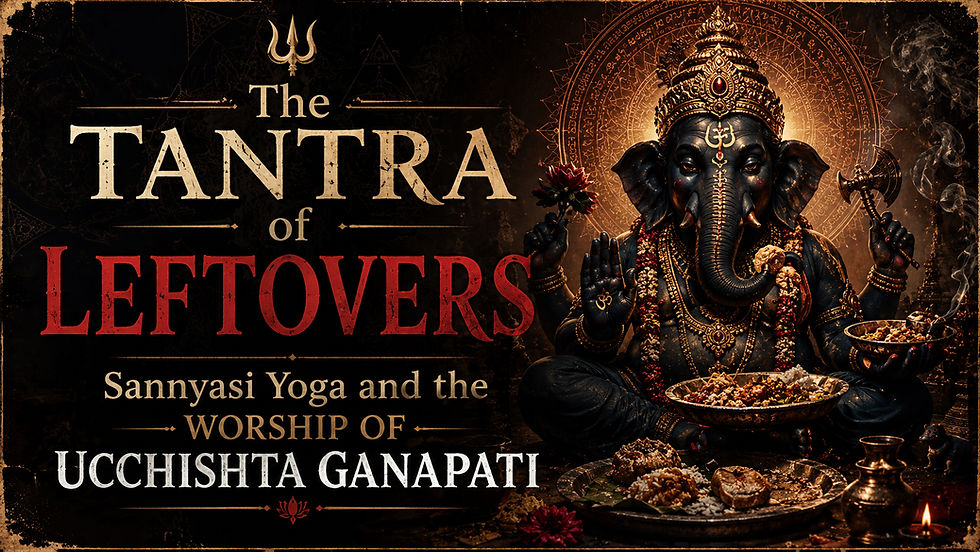
The Tantra of Leftovers: Sannyasi Yoga and the Worship of Ucchishta Ganapati

There is a conjunction that makes ordinary astrologers lower their voice.
Ketu, Saturn, and Venus, sitting together. Open most consultation notes and you will find it read as catastrophe. Ruined relationships. Poverty. Isolation. The pleasures of life curdling and withdrawing. Venus, the planet of love and beauty and everything sweet, crushed between the two great malefics, the shadow and the old cold lord of time.
They are not entirely wrong about the difficulty. But they have mistaken the crucible for the curse. Because this is not the signature of a ruined life. It is the signature of a renunciate soul, and it points toward one of the most intense and secret alignments in all of Jyotish, a path to liberation that runs not away from the impure, but straight through the middle of it.
To understand it, you have to meet three renouncers, one god of leftovers, and a truth about moksha that the comfortable will never accept.
The three renouncers
Start with the planets, because each of the three is, in its own way, a teacher of letting go.
Saturn is the great significator of renunciation. He is discipline, time, limitation, and tapas, the slow heat of austerity. But there is a deeper layer to Saturn that matters enormously here. Saturn rules the discarded. The outcaste, the lowborn, the rejected, the impure, everything society sweeps to its margins and refuses to touch. Saturn is comfortable in the places the pure will not go. Remember this, because it is the hinge of the entire teaching.
Ketu is the moksha karaka, the significator of liberation itself. He is the headless one, the planet of endings, of the past-life residue that has to be completed and released. Where Ketu sits, you have already been, many times, and you are finished with it. Ketu strips away. He gives disinterest in the very things the world runs toward. And Ketu, in the classical scheme, is ruled by Ganesha. Hold that too.
Venus is the one that confuses people, because Venus does not belong in a renunciation story. Venus is desire. Bhoga. Pleasure, romance, luxury, the sensual sweetness of embodied life. Venus is everything a renunciate is supposed to have left behind. So why is the planet of desire sitting at the very center of a yoga of liberation?
That question is the doorway. And the answer is the thing almost no one understands about this path.
Why the desire has to be there
You do not become a sannyasi by curbing your desire.
Read that again, because the entire spiritual internet is selling the opposite. The suppression of wanting, the white-knuckled denial, the pretense that you have transcended what you have merely buried. That is not renunciation. That is repression wearing saffron.
The tradition is explicit that Venus in a renunciation yoga is not a flaw to be removed. It is desire that must be controlled and channelized, and there is a world of difference between controlling a fire and pretending it was never lit. The soul that renounces through Venus is not the bloodless ascetic who never wanted anything. It is the one who wanted everything, who knew pleasure in its fullness, and who passed all the way through it and came out the far side no longer held.
This is the renunciation of the sensualist, not the puritan. The soul with this yoga cannot reach liberation by avoiding desire, because avoidance leaves the desire intact, waiting, alive in the dark. It has to go into desire, exhaust it, taste the whole of it, and let it burn down to ash on its own. Venus is present because this path demands that you renounce what you have actually known, not what you were too afraid to touch.
And that is where the leftovers come in.
Ketu is the leftover
Here is the key the ordinary reading misses entirely.
When the gods and demons churned the ocean of milk for the nectar of immortality, one demon, Svarbhanu, slipped into the line of gods and drank a drop. The Sun and Moon exposed him, and Vishnu severed his head. But he had already tasted the nectar, so he could not die. The head became Rahu. And the body, the severed remainder, the part left over after the head was gone, became Ketu.
Ketu is the leftover. He is, in the most literal cosmic sense, the remnant. What was left when everything else had been taken.
This is why Ketu carries the energy of the already-finished, the past-life residue, the thing you are done with but still carrying. And it is why, when Ketu joins Saturn, lord of the discarded, and Venus, the sum of your desires, the whole conjunction becomes a teaching about remnants. About the leftover cravings, the unfinished wanting, the residue of every desire you carried across every life and never fully burned.
The soul with this yoga is sitting on a lifetime of leftovers. And the tradition, through Ketu’s own deity, points it toward the one form of God who governs exactly that.
Ucchishta Ganapati, the god of remnants
Ganesha has thirty-two forms. Most people know the gentle ones, the remover of obstacles, the giver of beginnings, the round sweet god of thresholds and new ventures.
The eighth form is not gentle. He is Ucchishta Ganapati, and his name means leftovers.
Not leftovers in a soft sense. Ucchishta is the specific, potent, taboo word for the food remnant kept in the mouth, mixed with saliva, ritually impure, the thing orthodox purity culture will not touch and will not name. This is the Ganesha of that. The elephant god described as red in one tantric text and dark in another, the patron deity of the Ucchishta Ganapatya sect, one of the six great schools of Ganesha worship, and the most intense of them.
He is a tantric deity, worshipped through the vamachara, the left-hand path. And the defining feature of his worship is the thing that scandalized every orthodox commentator who ever wrote about him. He is worshipped by the devotee who is himself in the ucchishta state. Impure. Outside the rules. The sect that carries his name rejects caste and varna distinction, disregards the orthodox codes of purity, and worships the divine precisely from within the condition that mainstream religion calls unclean.
Understand what this deity actually is, past the fear and the colonial-era slander that painted him as mere degeneracy. Ucchishta Ganapati is the form of God who reveals that the divine is not found by fleeing the impure. It is found by passing through it until the very distinction between pure and impure dissolves. His iconography shows him in union with the Goddess, and the authentic reading of that image is not eroticism for its own sake. It is the oneness of Shiva and Shakti, the collapse of every duality, the truth that at the highest level there is no sacred and profane, no clean and unclean, no leftover and no first portion. There is only the one consciousness, wearing all of it.
That is why he is the deity of this yoga. A soul carrying the leftover desires of many lifetimes cannot reach moksha by declaring itself pure. It would be a lie, and the leftovers would still be there. It has to do what Ucchishta Ganapati does. It has to consume the remnant. To take the impure residue of its own wanting and pass it through the divine fire until impurity itself stops meaning anything.
The path of rolling through
So this is the tantra of leftovers, the actual spiritual mechanic the yoga demands.
The soul with Ketu, Saturn, and Venus conjoined does not get the clean ascetic’s road. It does not get to sit on a mountain having wanted nothing. Its Venus guarantees a life that knows desire intimately, that tastes the sweetness and the ruin of it. Its Saturn guarantees that the pleasures will be stripped, delayed, made heavy, turned in the end to ash. And its Ketu guarantees that underneath it all runs the pull toward liberation, the disinterest that grows sharper every time a desire is finally spent.
The work is to roll through the remnants. To meet each leftover craving, each unfinished attachment carried over from lives you cannot remember, and instead of suppressing it or drowning in it, to pass through it consciously until it is genuinely complete. Not denied. Complete. Burned down honestly until there is nothing left to pull you back.
Every desire consumed this way takes a portion of the ego with it, because the ego is nothing but the sum of what it still wants. Roll through enough of the leftovers, exhaust enough of the residue, and one day the self that was doing the wanting is simply not there anymore. That is the moksha this yoga is built for. Not the liberation of the person who never lived, but of the one who lived through everything and was finally emptied of it.
This is why it is so intense, and why the ordinary astrologer reads it as suffering. From the outside, a life of desires that never quite satisfy, of pleasures that turn to ash, of relationships that strip you down, does look like a curse. From the inside, for the soul that came here to be emptied, it is the most direct road there is.
A word before you go looking at your chart
You may not carry this exact conjunction. Full sannyasa signatures are rare, and even when they appear, they far more often produce an inner renunciate, a sadhu living in the middle of an ordinary life, than a literal monk who walks away from the world. The tradition is clear on this, and honest astrology has to be too. A renunciate soul is not always a renunciate biography.
But the principle underneath this yoga is not rare at all. Nearly every chart carries some contact between the planet of desire and the planets of dissolution, some house where Venus meets Saturn or Ketu, some corner of the life where pleasure is being slowly, deliberately turned to ash so that something can be released. That corner is your own small tantra of leftovers. The place where you too are being asked to pass through a desire completely, rather than around it, until it stops holding you.
The residue of past-life desire, where it sits, which knots it forms, which cravings are yours to finally complete in this life, is the deep karmic layer I read in the Karmic Knots reading through the D60. Not to frighten you about a difficult conjunction, but to show you which leftovers you came here to consume, and where the road out actually runs.
Ucchishta Ganapati eats what everyone else throws away, and finds God in it. The soul on this path is asked to do the same with the remnants of its own wanting. To stop fleeing the impure, and start passing through it, until there is nothing left to renounce and no one left to renounce it.


Comments