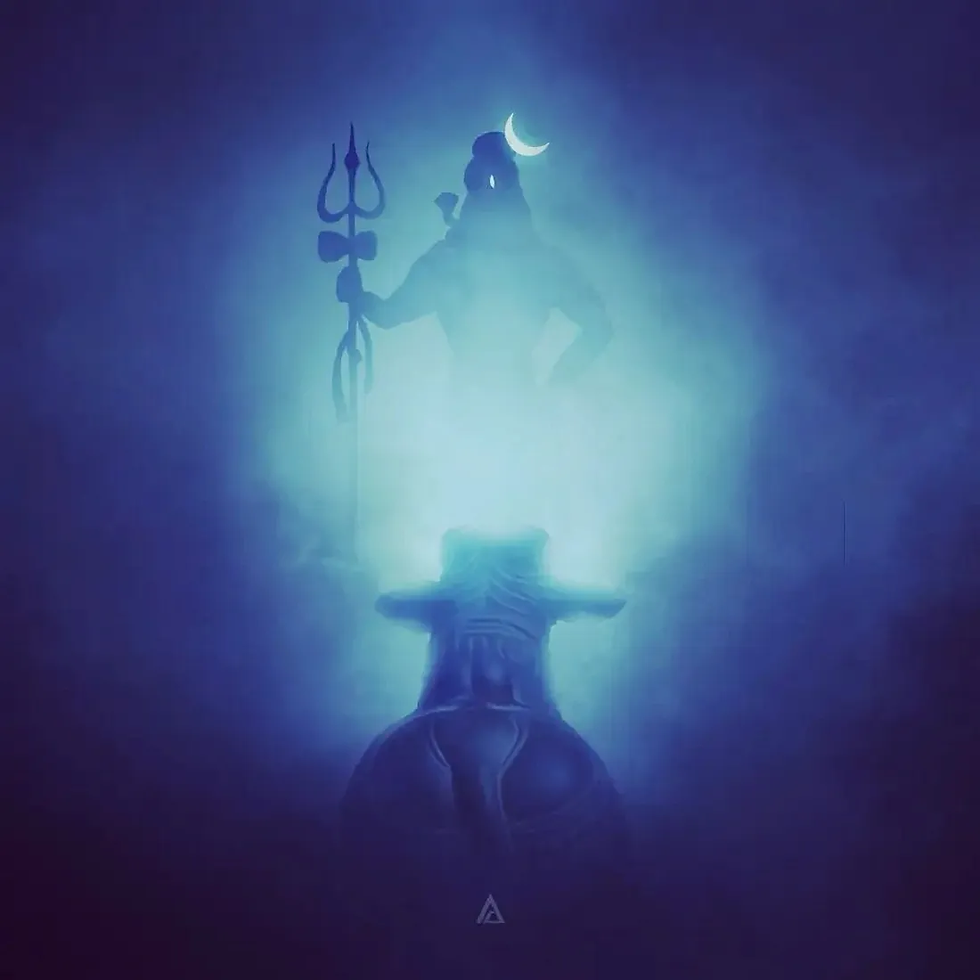
Shiva’s Manifestations Across Kalpas: The Ever-Repeating Cosmic Cycle


Introduction: The Eternal Cycle of Time and Divine Play
In Hindu cosmology, time is not linear but cyclical, an infinite repetition of creation, preservation, and dissolution. Each Kalpa (a cosmic day of Brahma, lasting 4.32 billion years) brings forth a new universe, and at its end, all creation dissolves, only to be reborn when the next Kalpa begins. Within these Kalpas exist Manvantaras (epochs of Manus) and Yugas (four world ages), organizing time into rhythmic cycles.
Because time endlessly repeats itself, divine events: the birth of gods, their cosmic battles, and their divine unions occur again and again, sometimes with variations. This concept, known as Kalpa Bheda, explains why Hindu scriptures often narrate multiple versions of the same story. A legend that happens in one Kalpa might occur slightly differently in another, yet the underlying essence remains unchanged.
Among the deities, Lord Shiva is one of the few constants across all cycles of creation. Though his forms and manifestations may shift, his role as the eternal yogi, cosmic destroyer, and divine consort of Shakti remains steadfast. This article explores how Shiva manifests in different Kalpas, how his divine partner Shakti incarnates anew, and how their cosmic dance shapes each universe that emerges and fades in the endless cycles of time.
1. Shiva’s Forms in Different Kalpas
Shiva, though beyond time and space, takes different forms in different Kalpas. According to the Liṅga Purāṇa, he assumes unique hues and aspects in each Kalpa, and sometimes the Kalpa itself is named after his manifestation.
Shiva’s Manifestations Across Kalpas:
Śveta Kalpa (White Kalpa):
Shiva appears in an all-white form: white garments, hair, and complexion.
Known as Sadyojāta, an aspect of Shiva associated with creation and purity.
Lohita Kalpa (Red Kalpa):
Shiva assumes a red-hued form, called Vāmadeva, embodying passion and preservation.
This aligns with his role as the loving consort of Shakti and the preserver of cosmic balance.
Pīta Kalpa (Yellow Kalpa):
Shiva appears in a golden-yellow form, associated with Tatpuruṣa, the meditative aspect of Shiva.
This represents his deep yogic nature, guiding ascetics and seekers toward liberation.
Kṛṣṇa Kalpa (Black Kalpa):
Shiva manifests as a dark-complexioned, fearsome form called Ghora (the terrible one).
He declares, “I am Kāla (Time), the reckoner of the worlds.”
This aligns with Shiva’s role as Mahākāla (the Great Time), responsible for cosmic dissolution.
However, he also promises to turn into Aghora (the peaceful one), indicating that destruction leads to renewal.
Viśvarūpa Kalpa (Universal Form Kalpa):
Shiva takes on a universal form, encompassing all of existence.
This corresponds with Īśāna, the aspect of Shiva that pervades all things.
Despite these varied manifestations, Shiva remains Mahādeva, the eternal yogi, the cosmic dissolver, and the changeless one beyond forms. His function in the universe remains the same, but his appearance, attributes, and role in cosmic events shift in different Kalpas.
2. Shakti’s Incarnations Across Kalpas: Sati and Parvati
If Shiva is the unchanging cosmic force, Shakti is the dynamic energy that flows through each cycle, manifesting in new ways across Kalpas. The Divine Mother (Ādi Shakti) takes birth again and again to restore balance, appearing as Sati, Parvati, Durga, Kali, and many other forms.
One of the most debated questions in Hindu cosmology is: Does Sati’s self-immolation and Parvati’s union with Shiva occur in every Kalpa?
The Repeating Story of Sati and Parvati
According to the Shiva Purāṇa, the Dakṣa Yajña episode where Sati immolates herself due to her father’s insult, leading to Shiva’s furious cosmic dance (Tāṇḍava) is a recurring cosmic event.
The Purāṇa states that in different Kalpas, Sati’s birth circumstances vary.
Some traditions say she is Daksha’s eldest daughter, while others say she is the youngest.
The same tragedy unfolds in different ways, but the end result — her reunion with Shiva as Parvati — remains constant.
Ancient sages like Kakabhūṣundi are said to have witnessed the Dakṣa Yajña multiple times across different Kalpas, suggesting that the separation and reunion of Shiva and Shakti is a divine drama that repeats eternally.
However, some texts like the Skanda Purāṇa propose a different timeline:
They claim that Sati’s sacrifice occurred in a previous Kalpa (Pitṛ Kalpa) and that Parvati’s birth and union with Shiva happened in the current Kalpa.
This would mean that not every Kalpa has a new Sati and Parvati story, but rather, once they unite, their marriage lasts across multiple Kalpas.
The Skanda Purāṇa even predicts that Parvati will remain united with Shiva for 180 Kalpas, suggesting that their divine love transcends creation and destruction cycles.
Thus, depending on the scripture, the Satī-Parvati cycle may either be a recurring event or a one-time cosmic resolution.
3. Devi’s Cosmic Battles in Different Kalpas
Beyond her role as Shiva’s consort, Devi takes independent warrior forms to restore balance whenever cosmic order is threatened. One of the most famous cycles is the battle of Goddess Durga against Mahīṣāsura, the buffalo demon.
The Mārkaṇḍeya Purāṇa (Devī Mahātmyam) narrates Durga’s famous battle against Mahīṣāsura.
However, some texts claim Mahīṣāsura was fated to be slain three times in three different Kalpas — each time by a different form of Devi:
Ugracandā — The 18-armed fierce form of Mahālakṣmī, destroying Mahīṣāsura in one Kalpa.
Bhadrakālī — A 16-armed, wrathful protector in another Kalpa.
Durgā (Kātyāyanī) — The 10-armed lion-riding goddess who killed him in the current Kalpa.
This suggests that Devi’s battles recur in every cosmic cycle, but her form and strategy change to match the specific needs of that era.
4. Why Do These Stories Repeat?
Hindu philosophy teaches that history repeats itself because the universe follows a cyclical rhythm, much like a grand cosmic play that is performed again and again for new audiences (souls) in each cycle.
The Bhagavad Gita (4.7–8) states:
“Whenever dharma declines and adharma rises, I manifest Myself.”
This applies not just to Vishnu’s incarnations but also to Shiva and Shakti’s recurring roles.
Kalpa Bheda (variations between Kalpas) allows the same divine events to happen anew, but with slight changes, keeping the cycle dynamic yet consistent.
Shiva and Shakti endure through all Kalpas, appearing in different ways but always fulfilling their cosmic roles: Shiva as the eternal presence beyond time, and Shakti as the active force that manifests anew to uphold dharma.
Conclusion: The Eternal Dance of Shiva and Shakti
Hindu cosmology presents a universe where divine stories are never-ending, playing out across Kalpas in slightly altered yet fundamentally similar forms. Shiva’s manifestations, Sati’s sacrifice, Parvati’s union, and Devi’s battles are not one-time events, but archetypal realities that recur eternally, ensuring the rhythm of cosmic balance remains unbroken.


Comments