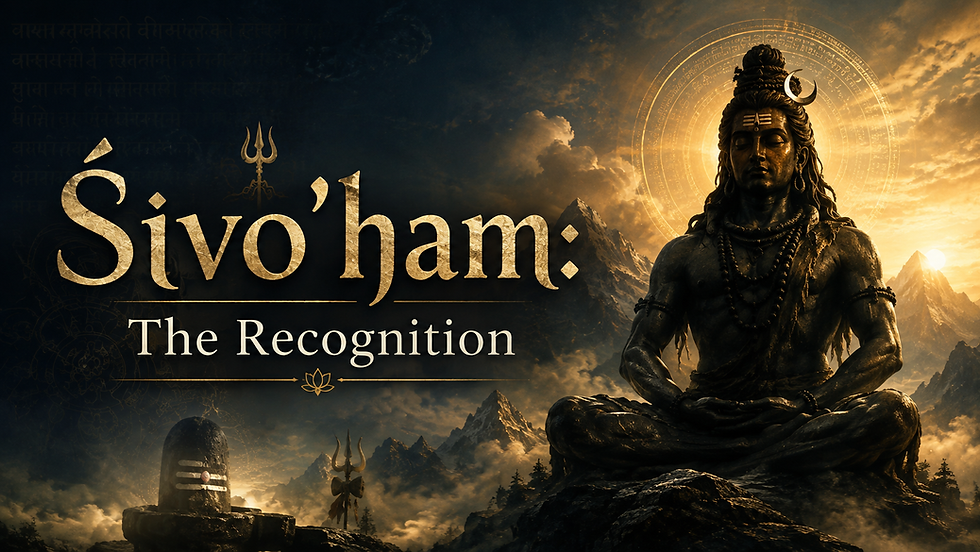
Śivo'ham: The Recognition

On the advanced course and why I could not teach it until now
There is a particular kind of woman I keep meeting.
She has done the work. She has wept at the altar. She has written the letters to Him and burned them, she has kept the vow, she has sat in the dark with her longing until the longing itself became a kind of company. Somewhere along the way, something opened. A night, a temple, a moment on a road and for a breath, or an hour, or three days, there was no distance at all. She knew. Not believed. Knew.
And then Tuesday came.
She woke up and made tea and answered a message from someone who does not respect her, and by evening she was small again. Smaller, maybe, than before because now she has the memory of largeness to measure herself against.
She writes to me and says: I touched it. Why can't I keep it?
This course is my answer to that question. And the answer is not what she expects.
The question is wrong
Here is the first thing this tradition will do to you: it will take your most sincere spiritual question and dismantle it.
Why can't I keep it?
Because "keeping" implies you had it and then lost it. Because "it" implies a thing separate from you. Because the woman asking the question has already decided she is the small one, and the vastness is the visitor.
Kashmir Shaivism turns this inside out. It says: you did not lose anything. You cannot lose what you are. What happened on Tuesday morning was not a departure. It was a contraction and that contraction has a name, a mechanism, and a way out that has been mapped in extraordinary detail for over a thousand years.
The name is aaṇava mala. And in Module 2 of this course, you are going to meet it face to face, and you are going to recognise it so precisely that you will never again mistake it for a personal failure.
What this tradition actually is
Let me be careful here, because there is a great deal of loose language circulating about Kashmir Shaivism, and I do not want to add to it.
Kashmir Shaivism, more properly the non-dual Śaiva Tantra that flowered in Kashmir between the ninth and twelfth centuries is not a mood. It is a philosophy with a technical vocabulary, a body of scripture, a lineage of commentators, and a graded system of practice. Abhinavagupta, its greatest synthesiser, wrote the Tantraaloka in thirty-seven chapters. Kṣemarāja, his student, wrote the Pratyabhijñāhṛdayam: the "Heart of Recognition" in twenty sūtras, and those twenty sūtras contain more than most modern spiritual books manage in three hundred pages.
Its central claim is this: there is only one reality, and it is conscious, and it is you.
Not "you are part of the divine." Not "the divine lives in your heart." You are That, and the entire drama of your spiritual life: the seeking, the longing, the practice, the tears is consciousness playing hide-and-seek with itself, for the sheer joy of the game.
The word for the path is pratyabhijnaa. It means recognition: literally, to know again. Not to acquire. Not to become. To recognise what was never absent.
Think of what happens when you meet someone in an unfamiliar city and cannot place them, and then suddenly you can. Nothing changed in them. Nothing was added to you. A veil dropped, and knowledge that was already present became available. That is the entire technology of this path.
This is why the course cannot be called She Who Becomes Him. There is no becoming. There is only the ending of a forgetting.
Why this course is only for women
I want to give you the real reasons, not the marketing ones.
Because Shakti is the knowing, not the decoration.
In this system, Shiva is prakaasha: light, pure being, the fact of existence. But light alone cannot know itself. What makes consciousness aware that it is conscious is vimarsha: self-reflective awareness and vimarsha is Shakti. Without her, Shiva cannot say I am. He is inert. A corpse, in the tradition's own blunt image.
A course about self-recognition is therefore, structurally, a course about Shakti. She is not the feminine flavour added to a masculine philosophy. She is the faculty by which the philosophy works at all.
Because freedom is her name.
We speak of svaatantrya: absolute autonomy, the freedom of consciousness to appear as anything, including as a woman who has forgotten she is free. This is not an attribute Shiva lends to Shakti. Svaatantrya-shakti is her own name. Freedom, in this tradition, is grammatically and philosophically feminine.
Because the lineage did this first.
This is the fact that settled the question for me. In the late ninth century, a Kashmiri master named Jnaananetra founded the Krama lineage. He directly initiated seventeen disciples. All three of his primary disciples were women including his successor, the siddha yogini Keyuravati, known respectfully and simply as "the Goddess K."
The Krama thus became the first pre-modern Indian tradition to grant women the status of full guru-hood, and it sustained master-to-disciple transmission across five centuries, from the ninth to the fifteenth while its radical non-dualism went on to shape the schools of Recognition, Vibration, and Trika itself.
Women were not admitted to this tradition as a concession. They carried it.
Because the manual exists because a woman refused a philosophical answer.
The Vijnaana Bhairava Tantra: the practice text this course leans on from Module 3 onward is a dialogue. Bhairavi asks Bhairava to reveal the essence of the path to the highest reality, and in answer he describes one hundred and twelve ways into the universal state of consciousness. But read the opening carefully and notice what she actually does: he gives her the abstract answer first, and she pushes back. She wants to know whether his essence can really be contained in mantras and syllables and energy centres or whether it is something else entirely. It is her refusal to accept the philosophical reply that prompts the revelation of the techniques.
One hundred and twelve doorways into non-dual awareness exist in written form because a woman would not settle for theory.
Because of Lalleshwari.
She is my lineage and I will not be neutral about her. A fourteenth-century Kashmiri woman who walked out of a marriage and a household and spoke this philosophy in the vernacular: not in scholars' Sanskrit but in Kashmiri, in verses short enough to be carried by shepherds and remembered by women who could not read. She is not a mascot for this course. She is proof that this tradition can live in a woman's body and come out as poetry.
And because of Module 4.
There is a teaching called matṛkaa shakti: the power of the letter, of language itself, to construct the self you believe you are. The inner voice that names you is not neutral. It is a shakti, and because you have not recognised it as one, it has been running you.
In Module 4 we take that teaching and apply it to the specific vocabulary women inherit: about worth, about the body, about desire, about taking up space, about being too much. That work requires a closed room. I am not willing to do it in a mixed one, and I am not going to pretend otherwise.
"Does this end my bhakti?"
This is the question I expect most. It is the right question, and it deserves a real answer rather than a reassuring one.
You came to Shivoham Path through Madhurya Bhakti. Through Him as Beloved. Through longing so specific it has a texture. And now I am telling you there is no other, no distance, no separation and something in your chest is already protesting: then what happens to my love?
Here is my answer, and it is not mine. It is the tradition's.
Utpaladeva was one of the towering philosophical minds of this lineage: the author of the Īśvarapratyabhijñā-kārikā, the text that gave the school of Recognition its systematic form. Rigorous, technical, uncompromising. If anyone had grounds to dissolve devotion into philosophy, it was him.
He also wrote the Śivastotrāvalī, a collection of hymns so drenched in longing, so wildly intimate, so unguarded in their weeping and their intoxication, that they remain among the most emotionally naked devotional poetry in the whole Sanskrit canon.
The same man. Not two phases of his life. The same mind, holding both.
Because in a non-dual system, devotion is not a strategy for closing a gap. Once you know there is no gap, love is no longer transactional, it is not for anything. It becomes the natural taste of consciousness recognising itself. The tradition has a word for this: camatkāra. Wonder. Aesthetic astonishment. The gasp.
Your bhakti does not die here. It stops being homesickness and becomes delight.
We begin the course with this in Module 1 and we return to it in Module 7. It is the spine of the whole thing.
What you will actually walk through
Seven modules. The structural logic is the tradition's own, the graded ladder of the upaayas, the means by which recognition is approached.
Module 1 — Caitanyam Ātmā: The Ground
The first sutra of the Śiva Sūtras: consciousness is the Self. We lay the non-dual claim out plainly, we handle the bhakti question directly, and we sit with the thirty-six tattvas, not to memorise them, but to locate yourself on the map. You will learn the ajapa mantra: the so'ham already occurring in your breath, the practice you do not have to perform.
Module 2 — The Forgetting: Malas and Kañcukas
The diagnostic module. The three impurities: āṇava (the wound of feeling small), māyīya (the sense of otherness), kārma (the story of being the one who does) and the five kanchukas, the cloaks that limit your power, your knowledge, your desire, your relationship to time, and your sense of what is possible for you.
I will tell you now what happens in this module, because it happens to nearly everyone: you will read a thousand-year-old list and find your own inner life described with uncomfortable accuracy. And then you will reach Step 5, where we make the turn, this is not your trauma. This is the architecture of manifestation. The contraction is not a flaw in your character. It is the first move of the universe becoming particular. That reframe lifts a weight most women have carried for decades.
Module 3 — Āṇavopāya: The Path Through the Body
Technique begins. Dvādaśānta, the two ends of the breath, the turning points where movement becomes stillness. Madhya, the centre, the pause, the gap. Uccāra and mantra-vīrya: mantra as vibration and potency rather than repetition and count. And nyāsa, placing the divine in the body, which quietly corrects a piece of language most of us inherited from elsewhere. Your body is not a vessel carrying something sacred. Your body is the sacred, condensed.
Module 4 — Śāktopāya: The Path Through the Mind
Vikalpa, the constructed thought that builds the world you then experience as given. Śuddha vikalpa, the pure thought, installed through bhāvanā, which is not affirmation but contemplation held so long that it stops being an idea and becomes perception. And mātṛkā śakti, described above.
This is the module that will shake you. It is placed in the middle deliberately, with support on both sides.
Module 5 — Śāmbhavopāya: The Path of Will
Icchā. The flash. No method at all, only the dropping of construct.
This module is deliberately the shortest and the starkest, because the form should teach what the content says. We work with bhairavī mudrā, eyes open, gaze outward, awareness turned in, the world fully visible and no longer other. And with the dhāraṇās that open at the edges of intensity: the instant before desire names its object, the peak of joy, the moment of sudden fright.
(A note, plainly: these are approached from a settled practice, and we do not manufacture intense states to chase them.)
Module 6 — Śaktipāta and Anupāya: Grace
The limits of effort. Śaktipāta, the descent of grace, in its intensities from the overwhelming to the barely perceptible and anupāya, the pathless path, where method itself is set down.
This is where Lal Ded lives. You will take one of her vākhs and stay inside it for seven days.
Module 7 — Jīvanmukti: Living as Her
Liberation while living, the tradition's actual goal, not a posthumous reward. Kramamudrā, the state where inner and outer stop alternating and begin to interpenetrate. Camatkāra as your default flavour. Recognition tested where it actually gets tested: the kitchen, the argument, the traffic, the relative who diminishes you at a wedding.
And then the close. In She Who Becomes Him, we ended with the Pati Bhava inner wedding, the marriage within. This course ends with its opposite: not a wedding, but the end of anyone left to marry. We close with svātantrya, freedom returned to her own name.
Who this is for
Women who have already tasted union and want to know what to do with the rest of their lives
Women whose bhakti is intact but whose mind wants rigour who are tired of spirituality that cannot survive a serious question
Women who suspect their smallness is not the truth about them
Sadhikas who want technique, not inspiration
Who this is not for
Anyone looking for a gentle first step. This is advanced, and the vocabulary is real.
Anyone who wants their spiritual life confirmed rather than restructured
Anyone unwilling to sit with Sanskrit terms. I will not water them down, precision is the gift this tradition offers, and translating everything into soft English destroys the thing you came for.
What you receive
Seven modules, seven steps each, with the final module extended for integration
Each module: written teachings, guided practices, ritual, a recorded lecture, and a workbook
Self-inquiry inventories in place of quizzes, a short doctrine check, paired with a recognition log. I am not interested in what you felt. I want to know what you caught yourself being.
A recommended pacing of seven weeks, with an integration pause before Module 6
A closed circle of women walking it at the same time
The source texts we work from: the Pratyabhijñāhṛdayam of Kṣemarāja; the Śiva Sūtras with his commentary; the Spanda Kārikās; the Vijñāna Bhairava Tantra; Abhinavagupta's Tantrāloka; Utpaladeva's Śivastotrāvalī; and the vākhs of Lalleshwari throughout.
Why I could not teach this before
She Who Becomes Him was true. I do not disown a word of it. It was the map I had, and it took a great many women a great distance.
But it was a bridge and a bridge assumes two shores.
I could not teach what I am teaching now until I had lived long enough on the far side to know that the crossing had been imaginary. That there had never been two. That the longing I had spent years refining was itself Shiva, arriving as longing, because that was the form I was able to receive Him in at the time.
Union was where the last course ended.
It is where this one begins.
Śivo'ham. I am Shiva. Not a claim. A memory.
Enrolment closes by last week of August, 2026. Women who have completed She Who Becomes Him will be invited first. Śivo'ham: The Recognition

So beautifully put, does my love die here? Nope, he said. He is my love and when the love itself is me. Why do my love die. It just becomes more him ❤️